Samashrayanam (Panchasamskara) – Sacred Initiation into Sri Vaishnavism
Introduction
Samashrayanam is the sacred initiation ceremony through which a devotee formally becomes a follower of the Sri Vaishnava tradition.
The ceremony is also called Panchasamskara, meaning “five sacred purifications or transformations.” Through this ritual, a disciple receives spiritual guidance from an Acharya (Guru) and dedicates their life to the service of Vishnu and Lakshmi.
Samashrayanam represents a spiritual rebirth, where the devotee formally enters the Sri Vaishnava sampradaya and commits to following the teachings of the Acharyas.
Meaning of Samashrayanam
| Term | Meaning |
| Sama | Equal or proper |
| Ashraya | Taking refuge |
| Samashrayanam | Taking refuge in the divine through an Acharya |
The ceremony signifies complete surrender (Sharanagati) to Lord Narayana under the guidance of a Guru.
Importance in Sri Vaishnava Tradition
Samashrayanam is considered essential for anyone who wishes to follow the Sri Vaishnava path sincerely.
It teaches the devotee to:
- Surrender to Lord Narayana
- Follow the teachings of the Acharyas
- Practice devotion and humility
- Perform daily spiritual disciplines
- Serve the community and temple
Through this initiation, the disciple becomes spiritually connected to the Guru-parampara (lineage of teachers).
Who Can Receive Samashrayanam?
| Category | Eligibility |
| Men | Can receive initiation |
| Women | Can receive initiation |
| Children | Can receive with parents’ guidance |
| Adults | Can receive anytime |
Unlike some other samskaras, Samashrayanam is open to all devotees seeking spiritual guidance.
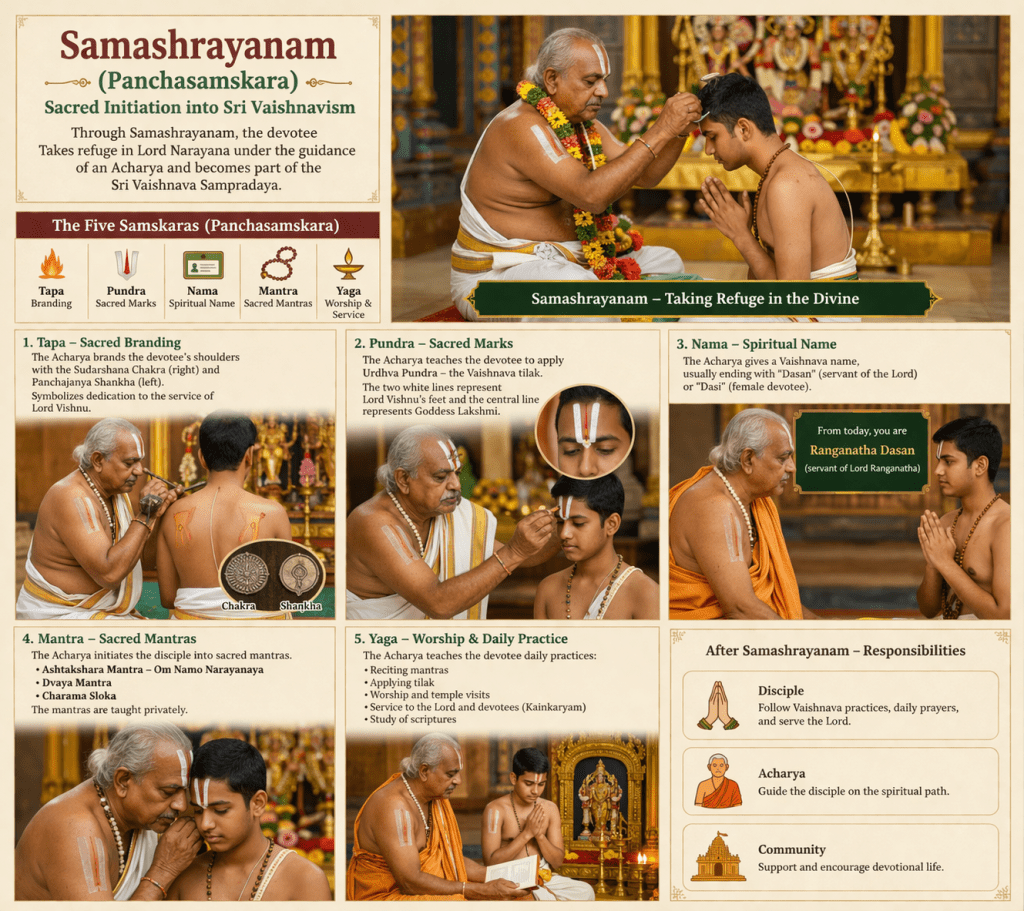
The Five Samskaras (Panchasamskara)
The ceremony includes five sacred rites performed by the Acharya.
| Samskara | Meaning | Description |
| Tapa | Branding | Symbolic marking of Vishnu symbols |
| Pundra | Sacred marks | Teaching the application of Vaishnava tilak |
| Nama | Spiritual name | Receiving a Vaishnava name |
| Mantra | Sacred mantras | Initiation into divine mantras |
| Yaga | Worship | Learning daily worship practices |
Detailed Explanation of the Five Samskaras
1. Tapa – Sacred Branding
During this step, the Acharya places heated metal seals representing the conch (Shankha) and discus (Chakra) on the devotee’s shoulders.
| Symbol | Meaning |
| Shankha | Divine sound and protection |
| Chakra | Power of Lord Vishnu |
These markings symbolize complete dedication to the service of the Lord.
In modern ceremonies, this may sometimes be performed symbolically rather than through actual branding.
2. Pundra – Vaishnava Tilak
The Acharya teaches the disciple how to apply the Urdhva Pundra, the sacred Vaishnava mark worn on the forehead and other parts of the body.
The mark consists of two white vertical lines with a central red/yellow line, representing the feet of Lord Vishnu and Goddess Lakshmi.
| Element | Symbolism |
| White lines | Feet of Lord Vishnu |
| Central line | Goddess Lakshmi |
| Shape | Path leading toward the divine |
3. Nama – Receiving a Spiritual Name
The Acharya gives the disciple a Vaishnava name, usually ending with “Dasan” or “Dasi”, meaning servant of the Lord.
Examples:
| Name | Meaning |
| Ranganatha Dasan | Servant of Lord Ranganatha |
| Narayana Dasi | Servant of Lord Narayana |
This name symbolizes humility and dedication.
4. Mantra – Initiation into Sacred Mantras
The Acharya teaches the disciple important Vaishnava mantras.
These may include:
| Mantra | Meaning |
| Ashtakshara Mantra | “Om Namo Narayanaya” |
| Dvaya Mantra | Prayer to Lord Narayana and Lakshmi |
| Charama Sloka | Teaching of surrender from the Bhagavad Gita |
The mantras are taught privately to emphasize their sacred nature.
5. Yaga – Learning Worship Practices
The disciple is taught the basic practices of daily devotion.
| Practice | Description |
| Daily prayers | Reciting mantras |
| Temple worship | Visiting temples |
| Service (Kainkaryam) | Serving the Lord and devotees |
| Study | Learning scriptures |
This final step prepares the disciple for a life centered on devotion and service.
Items Required for Samashrayanam
| Item | Purpose |
| Tulasi leaves | Sacred offering |
| Sandal paste | Tilak application |
| Flowers | Worship offerings |
| Fruits | Puja offering |
| Betel leaves and nuts | Traditional ritual items |
| Camphor | Aarti ritual |
| Holy water | Purification |
Responsibilities After Samashrayanam
| Role | Responsibility |
| Disciple | Follow Vaishnava practices |
| Acharya | Provide spiritual guidance |
| Community | Support devotional life |
Spiritual Meaning of Samashrayanam
| Element | Meaning |
| Branding | Dedication to Lord Vishnu |
| Tilak | Identity as a Vaishnava |
| Spiritual name | Humility and service |
| Mantras | Connection to divine grace |
| Worship | Daily devotion |
Frequently Asked Questions
Is Samashrayanam mandatory in Sri Vaishnavism?
It is considered essential for formally entering the Sri Vaishnava tradition.
Can women receive Samashrayanam?
Yes, women can receive the initiation.
Can it be done at any age?
Yes, devotees can receive Samashrayanam at any stage of life.
Is the branding painful?
Traditionally it is done with heated seals, but some Acharyas perform it symbolically.
Conclusion
Samashrayanam is a deeply meaningful spiritual ceremony that connects a devotee to the Sri Vaishnava lineage and the teachings of the Acharyas.
Through the five samskaras, the disciple learns surrender, devotion, and service to the divine.
With the blessings of the Guru and the grace of Lord Narayana, the devotee begins a lifelong journey of bhakti, humility, and spiritual growth.
 Site Title
Leave a comment